Affordable Gynecology Treatment in Mohali | Expert Women's Healthcare
- July 10,2026
One of the most common questions couples ask during fertility consultations is:
"Doctor, should we continue trying naturally, or is it time to consider IVF?"
This is an important question, and the answer is different for every couple. While many couples conceive naturally, others may require medical assistance due to age, hormonal problems, blocked fallopian tubes, male infertility, PCOS, endometriosis, or unexplained infertility.
As a fertility specialist, my first priority is always to understand the reason behind the difficulty in conceiving. IVF is an excellent treatment option for many couples, but it is not the first treatment recommended for everyone.
In this guide, we'll compare IVF and natural pregnancy, explain their advantages, discuss success rates, and help you understand which option may be best for your individual situation.
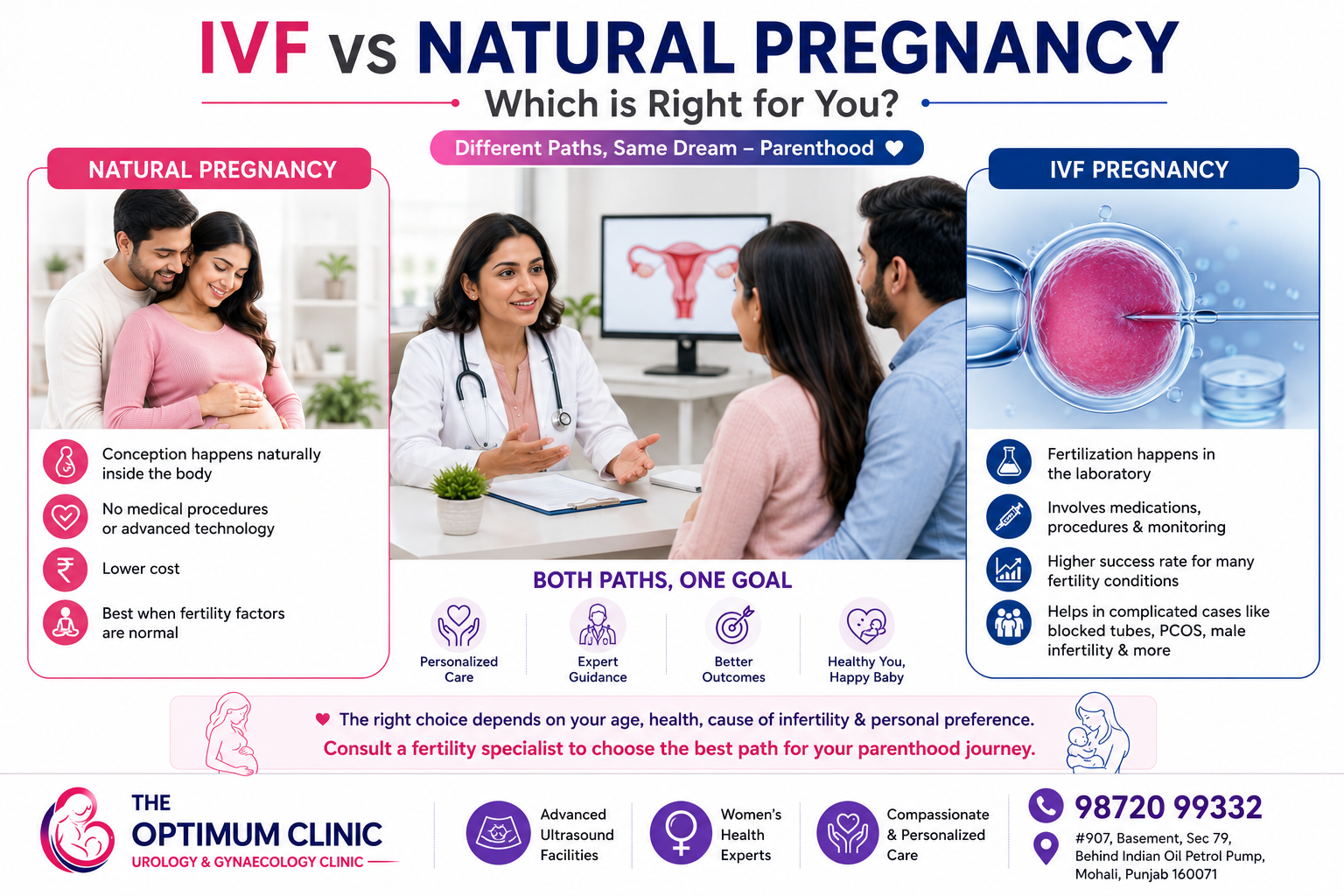
Natural pregnancy occurs when a healthy egg is released from the ovary, fertilized by sperm inside the fallopian tube, and then implants naturally in the uterus.
For natural conception to occur successfully, several factors need to work together:
When all these factors are normal, pregnancy can occur without medical intervention.
IVF (In Vitro Fertilization) is an advanced fertility treatment in which eggs are collected from the ovaries and fertilized with sperm in a specialized laboratory. The resulting embryo is then transferred into the uterus to achieve pregnancy.
IVF has helped millions of couples worldwide become parents and is one of the most effective fertility treatments available today.
| Natural Pregnancy | IVF Pregnancy |
|---|---|
| Fertilization happens inside the body. | Fertilization happens in a laboratory. |
| No fertility medications in most cases. | Usually involves fertility medications. |
| No medical procedures. | Egg retrieval and embryo transfer are required. |
| Lower cost. | Higher treatment cost. |
| Depends completely on natural fertility. | Helps overcome many infertility problems. |
Natural conception is usually recommended for couples who:
IVF may be recommended if you have:
Many women with PCOS become pregnant naturally after lifestyle changes or ovulation induction. However, if pregnancy does not occur despite treatment, IVF may be considered.
Read More:
Yes.
Endometriosis can reduce fertility in some women by affecting the ovaries, fallopian tubes, or pelvic environment. Depending on the severity, your doctor may recommend medication, laparoscopic surgery, or IVF.
Before recommending IVF, your fertility specialist usually performs:
Learn About Gynecology Ultrasound
Absolutely.
Healthy lifestyle habits improve fertility naturally and may increase the success of fertility treatments.
Every couple's fertility journey is unique. IVF is a highly successful treatment for many people, but it is not always the first or only option. A proper fertility evaluation helps determine whether natural conception, medication, IUI, or IVF is the most appropriate path. Early consultation often improves the chances of achieving a healthy pregnancy.
No. IVF is recommended when natural conception is difficult or unlikely due to specific fertility problems.
Yes. Many couples conceive naturally after treating the underlying cause of infertility.
No. Many couples first benefit from lifestyle changes, medications, or IUI before IVF is considered.
Yes. Many women with PCOS achieve pregnancy naturally or with simple fertility treatments.
The Optimum Clinic
#907 Basement, Sector 79,
Behind Indian Oil Petrol Pump,
Mohali, Punjab
98720 99332