Percutaneous Nephrolithotripsy (PCNL), often abbreviated as PNL, represents the gold standard for surgically removing large, complex, or unusually hard kidney stones. This is a highly effective, minimally invasive endoscopic treatment designed for patients diagnosed with:
Large Kidney Stones: Stones typically exceeding 2 cm in diameter.
Staghorn Calculi: Complex stones that branch out and occupy multiple collecting areas of the kidney.
Multiple Stones: Numerous stones located in the kidney or upper ureter.
At The Optimum Clinic, we utilize the latest technology to perform Percutaneous Nephrolithotripsy with high precision, ensuring complete stone clearance with minimal impact on the patient.
The Percutaneous Nephrolithotripsy (PCNL) procedure is performed under general anesthesia. It relies on advanced imaging and specialized surgical equipment:
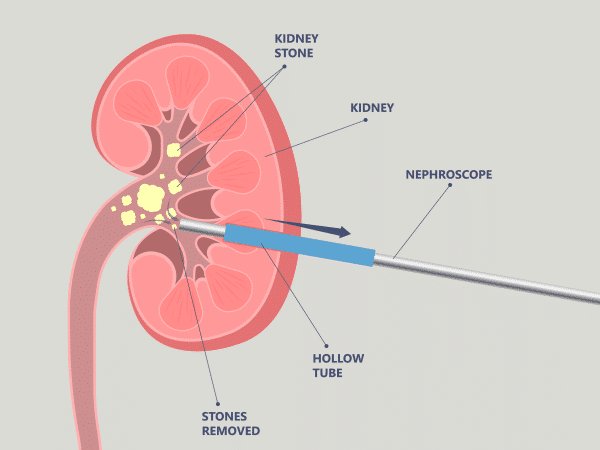
Access Creation: A tiny puncture is created in the skin, through the back, leading directly into the kidney’s collecting system where the stone resides. This is achieved without the need for a large incision associated with traditional open surgery.
Telescopic Port Insertion: A specialized telescopic port (the working channel) is inserted through this small puncture site.
Visualization and Fragmentation: A telescope known as a nephroscope is passed through this port. Using real-time X-ray control called fluoroscopy, the surgeon accurately visualizes the stone. The stone is then disintegrated and broken into small pieces using laser or ultrasonic energy (lithotripsy).
Removal: All stone debris and fragments are removed completely during the surgery through the working channel. The entire procedure typically lasts for 1 to 2 hours.
When performed by an experienced urologist, Percutaneous Nephrolithotripsy offers prominent advantages for patients with large or complex stones:
Minimally Invasive: It eliminates the large skin incision and prolonged recovery caused by previous open kidney surgery for stones.
Complete Clearance: It allows for the immediate removal of all stone fragments during surgery, significantly reducing the chance of residual stones that can lead to recurrence.
Faster Recovery and Healing: Compared to more extensive procedures, patients experience less pain and much faster healing.
Shorter Hospital Stay: Patients typically enjoy a shorter hospital stay, usually just 2 or 3 days, allowing a quicker return to normal daily activities.
While standard Percutaneous Nephrolithotripsy is highly effective, Dr. Rajan Sharma focuses on advanced, minimally invasive variations, such as Mini-PCNL. Utilizing smaller instruments dramatically reduces the size of the access tract, further lessening trauma, blood loss, and ensuring an even quicker recovery profile for the patient.
Percutaneous stone surgery is also recommended in certain complex conditions, including:
Obstruction of the ureter below one of the kidneys.
Specific anatomical challenges like ureteropelvic junction obstructions.
Stones that have proven highly resistant to shock wave lithotripsy (ESWL).
Choosing a highly experienced clinic is essential for the success of complex surgeries like Percutaneous Nephrolithotripsy (PCNL). Our commitment is to utilize advanced technology and precision techniques to treat your kidney stones safely and completely.
If you have been diagnosed with a large or complicated kidney stone, scheduling a consultation with Dr. Rajan Sharma will provide you with a comprehensive assessment and a personalized treatment plan utilizing the most effective and least invasive techniques available.